Wedding Words
How to Write a Wedding Speech That Feels Genuine and Memorable
Turn one good story into a clear wedding speech, with an editable outline, original sample, and practical delivery checklist.
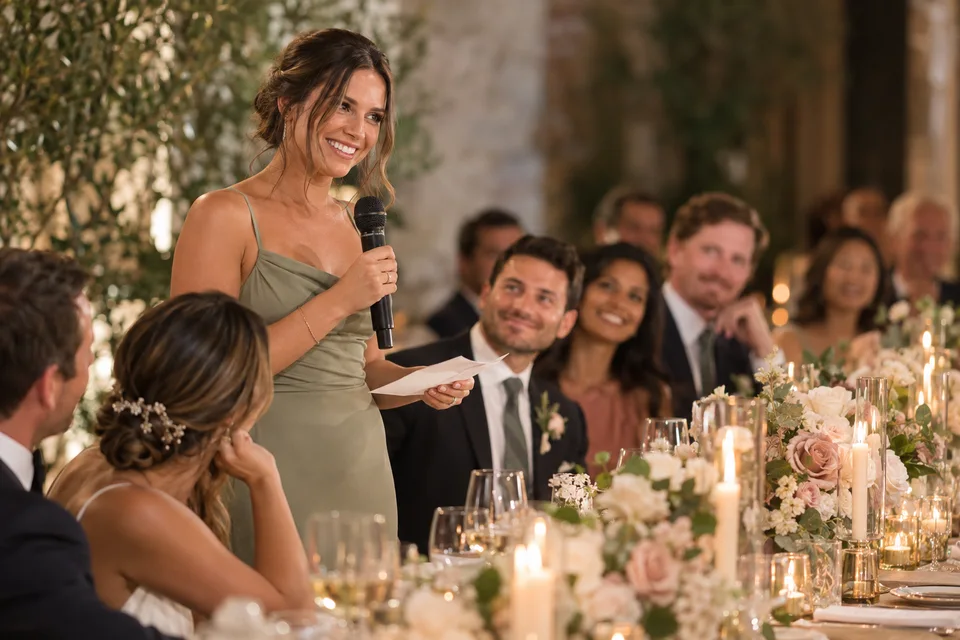
A good wedding speech welcomes the room, tells one revealing story, includes both partners, and ends with a clear wish or toast. Start with the relationship you want to celebrate rather than a joke you hope will impress people. One well-chosen moment usually says more than a list of compliments.
Ask the couple or coordinator for your speaking window and the running order before writing. The sample below is a structure to adapt, not a mandatory script. Read your finished draft aloud and time it; the right length is the length you have actually agreed to deliver.
Decide what you want the room to understand
Complete this sentence: “By the end, I want everyone to see how…” Perhaps the answer is how the couple supports one another, how a sibling has grown, or how friendship has become family. This is your organizing idea.
Write down three possible stories, then choose the one that demonstrates that idea most clearly. It does not need to be dramatic. A small act of consideration can reveal more about a relationship than a travel adventure that takes five minutes to explain.
Choose a story with consent and context
Use a moment that both partners would feel comfortable hearing in front of their guests. Avoid stories involving former relationships, private conflicts, intoxication, sexual details, or personal information shared in confidence. If you are uncertain, ask the person involved rather than treating surprise as part of the entertainment.
Keep the setup short: where you were, what happened, and what the moment showed you. Remove side characters who do not matter to the point. An inside joke is not automatically funny to a room that has never heard the backstory.
A five-part speech outline
- Introduce yourself. Name your relationship to the couple in one sentence.
- Offer a welcome or thanks. Match your role and avoid duplicating the host's full announcements.
- Tell one story. Give a clear beginning, a small turning point, and a meaning.
- Include the partnership. Address both people and connect the story to their relationship.
- End deliberately. Offer a warm wish and invite a toast if that is part of the event.
You can move these pieces around. A parent may begin with a welcome; a friend may open with a brief memory. What matters is that listeners know who is speaking, why the story matters, and when the speech has reached its ending.
An original sample to adapt
“Hello, everyone. I'm Sam, one of Jamie's oldest friends. Thank you for making room for so much love in one place today.
A few years ago, I arrived for dinner after a difficult week. Jamie had burned the first attempt at the meal, and Rowan was making a second one while Jamie put flowers in an old jar. Nobody tried to make the evening perfect. They simply made it welcoming.
That is what I admire about you both. You notice what people need, you share the work, and you make ordinary moments feel like somewhere we want to stay.
Jamie and Rowan, I hope your marriage holds many evenings like that: room for a little mess, something good to share, and the confidence that you are on the same side. Please join me in wishing them a joyful life together.”
This is a fictional illustration, not an account of real people. Replace the story entirely with a true one you have permission to share. Keep the plain structure and the move from a specific moment to a wish for the couple.
Make the second partner visible
If you know one person much better, do not invent closeness with the other. Describe what you have genuinely observed, or say how happy you are to celebrate them together. “I look forward to knowing you better” can be warmer than an exaggerated claim about an instant bond.
Check pronunciation and names. Avoid making the new partner the punchline or congratulating them for managing your friend. Praise qualities rather than suggesting that marriage has repaired somebody's personality. The couple should feel supported by the story.
Use humor as seasoning
One affectionate observation is enough. A speaker can be engaging without performing a comedy routine. If a line needs “Don't worry, they can take a joke” as its defense, remove it. The audience includes people with different relationships to the couple and different ideas of what is private.
Pause after a light moment instead of racing ahead. If the room does not laugh, continue calmly. Avoid adding improvised teasing to recover attention. The speech's purpose is still to celebrate the couple, even when the room is quieter than expected.
Edit for the ear
Read the draft aloud and shorten sentences where you run out of breath. Replace abstract compliments with concrete details. “You checked everyone had a ride home” is easier to picture than “You are an embodiment of extraordinary kindness.” Remove repeated thanks and several versions of the same closing wish.
Mark pauses and print the speech in a size you can read at arm's length. Use short paragraphs, page numbers, and a secure folder or cards. If you use a phone, make the text available offline and silence notifications before you stand up.
Rehearse the physical delivery
Practice standing, holding your notes, and looking up at the end of a sentence. Ask how to use the microphone and whether it will be handed to you or placed on a stand. Keep water nearby if appropriate, and avoid speaking while servers are making announcements.
Arrange a signal with the coordinator so the speech starts at the right time. If you become emotional, pause and breathe before continuing. You do not need to apologize for caring. A trusted backup can hold a spare copy if you think you might need support.
Close while the meaning is clear
Write the last sentence in advance. Invite guests to join your wish in the way the event permits; nobody needs an alcoholic drink to participate. Do not add an unrelated quotation after your strongest closing line.
A genuine speech sounds like someone who knows why they are speaking. Keep one true story, a clear connection, and a kind ending. For a shorter written message, use our wedding card examples. If you are also helping plan the day, the planning guide will help place speeches in the schedule.
Published by Anna’s Weddings Editorial. Examples are illustrative; planning suggestions should be adapted to your location, venue, and circumstances. Read our editorial standards.